Tyler Gordon | Last Updated: June 9, 2026
Resale is one of the most attractive corners of retail right now. According to ThredUp’s 2026 Resale Report, the U.S. secondhand apparel market grew 19% in 2025 – more than 3x faster than broader retail clothing – and is on track to reach nearly $80 billion by 2030. Buying secondhand also resonates with the value-driven Millennial and Gen Z shoppers every retailer is chasing.
The tailwinds behind that growth are incredibly durable. Resale has historically held up well in both strong and weak economies. What’s more, for younger generations, buying secondhand has shifted from a necessity to make ends meet to a first choice. It’s equal parts budget and values. That combination, strong demand in any climate plus a customer base that keeps growing, is what makes resale such a compelling place to build a business. It is also why the field is getting more crowded, and why standing out matters more than ever.
All in, for anyone considering a resale clothing franchise, the question isn’t whether the opportunity exists. It’s how do you stand out.
Value Gets You in the Door. It Doesn’t Set You Apart.
Start with how a shopper first decides to thrift. If a new shirt and a used one cost the same, almost everyone buys new. So secondhand shopping has to offer a real discount to earn the sale. Add the thrill of the hunt – that rush of finding something great for a fraction of the price – and you have the two forces most secondhand stores run on: price and discovery.
The problem is that most thrift stores stop there. The racks are crowded, quality is a gamble, fixtures and lighting are tired, and the brands are hit or miss. “Thrift store dusty” is prevalent.
Over time, shoppers are quietly trained to accept a trade: real savings in exchange for an underwhelming, sometimes genuinely unpleasant, experience. That trade is the ceiling most resale concepts never break through. They win on price, lose on everything else, and then wonder why their best customers drift away.
Resale Without Compromise
Uptown Cheapskate was built to erase that trade-off. The premise is easy to say and hard to execute: keep the unbeatable value, then remove every reason a shopper would settle for less. On top of value, an Uptown store layers four elements most secondhand shops do not.
- Quality assortment. Our stores do the curation so customers don’t have to. Every item is screened for brand, condition, and current style before it reaches the floor. Damaged or dated pieces are declined or donated, not displayed. What’s left is a floor stocked with items and brands shoppers love – all at a fraction of full-price retail.
- Buying and selling happen in one clean, well-organized place that respects a customer’s time. A customer can turn last season’s closet into cash and walk out with this season’s wardrobe in a single visit.
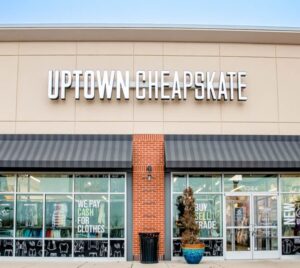
- A boutique experience. Uptown stores are bright, thoughtfully merchandised, and genuinely enjoyable to spend time in. Plenty of first-time visitors don’t realize they are standing in a resale store until they look at the price tags.
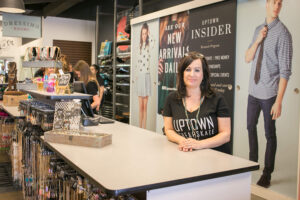
- The best stores are not transactional. Regulars know the staff, the buy counter becomes a relationship rather than a transaction, and the store becomes part of the rhythm of the neighborhood.
Stack those layers and you get a fundamentally different business. Most thrift stores compete on value and the thrill of the hunt alone. Uptown competes on value, discovery, assortment, convenience, experience, and connection all at once.
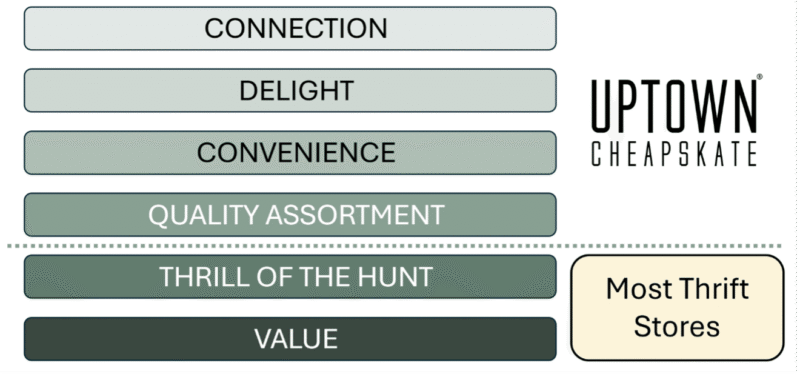
Uptown Cheapskate delivers value across all six layers of the customer experience, where most resale stores stop at two.
You can see the difference in how customers respond. Across more than 160 locations, Uptown stores have earned an endless number of five-star reviews. What’s more striking though is what those reviews actually say. They rarely stop at “good prices.” Shoppers describe stores as clean, welcoming, and easy to spend an afternoon in. They mention staff by name. The impression Uptown leaves reaches past value into something closer to emotional resonance, and that feeling is exactly what turns a one-time deal-hunter into a loyal regular. That loyalty compounds. Regulars shop more often, bring their friends, and become the steady traffic a healthy store is built on.
So, It’s All Just Aesthetic? Not Quite.
You might be wondering whether all of this is just a fresh coat of paint on an old idea. It’s not. Consistent curation, fast-turning inventory, and a polished, well-staffed store are operationally demanding. They depend on disciplined systems, trained teams, and a real commitment to throughput, which is precisely why most resale stores can’t pull it off. Uptown’s systems are built on 30+ years of innovation and learning and are powered by an industry-leading software stack that is unlike anything else in resale. These are the advantages that keep Uptown’s position defensible and are hard for a copycat down the street to replicate.
Standing Still Is the Fastest Way to Fall Behind
No advantage in retail holds on autopilot. The reason Uptown has kept its edge is a refusal to be satisfied with the status quo. The brand reinvests continually across operations, marketing, technology, and analytics. Then there is Uptown’s proprietary software suite, Baseline, which turns what used to be guesswork in resale into data-driven decision making: what to buy, how to price it, and when to move it. These investments point toward the same goal: the “wow” moment that keeps customers coming back. A concept that keeps raising its own bar is a concept that stays ahead of the field.
Why a Differentiated Resale Clothing Franchise Is a Better Business
Here is the part that matters most if you are evaluating ownership. The experience that delights customers is the same engine that drives store-level economics. A floor full of in-demand brands sells faster. Faster sell-through means higher throughput, and in resale, throughput is the key to success. A great experience brings customers back, which keeps both sides of the buy-and-sell firing on all cylinders. Differentiation is not just a marketing layer sitting on top of the business. It’s every facet of the business and its operations, and it shows up directly in the unit economics.
The numbers reflect that economic potential. According to Item 19 of Uptown Cheapskate’s 2026 Franchise Disclosure Document, the system average franchised location generated $1,405,704 in gross sales and $227,359 in net income. The top quartile average expanded to $2,192,785 in gross sales and $423,443 in net income. Set against a total investment of $364,015 to $682,215 (Item 7, midpoint $523,115), the system-average net income works out to an unlevered yield north of 40%. While results vary by location, operator, and market, those results speak to the potential for high-quality franchisees.
That return profile exists because Uptown’s differentiation is real and durable. A concept that competes on price alone eventually gets squeezed. A concept customers genuinely love has room to keep running, especially when it operates in an industry forecasted to reach nearly $80 billion. Layer on territories available across much of the country, and it’s also a model that offers multi-unit potential over time.
The Experience and the Opportunity Are the Same Thing
The resale stores that win over the next decade will not be the ones that rely exclusively on low prices. They will be the ones that combine deep value with an uncompromising customer experience. The experience Uptown creates for customers and the opportunity our stores offer franchise owners are not two separate stories. They are the same story, told from two sides of the same counter.
If that is the kind of business you want to build, we would welcome the conversation. The best place to start is understanding how the model works and whether your market is open. You can request franchise information to begin the discovery process, and from there we will help you dig into the details and decide, together, whether franchise ownership with Uptown is the right fit.
About the Author:
Tyler Gordon is the Co-CEO of BaseCamp Franchising, the parent company of Uptown Cheapskate and Kid to Kid. At BaseCamp, Tyler helps oversee two of the fastest thrift brands in the United States, with operations that span close to 300 stores. Tyler received his MBA from Harvard Business School and his BA in economics from Harvard College. Tyler and his wife Lindsay live in Salt Lake City with their two young children.
LEGAL DISCLAIMER
Financial performance data sourced from Item 19 of the Uptown Cheapskate 2026 Franchise Disclosure Document, franchised locations only, for the period November 1, 2024 through October 31, 2025. Investment figures sourced from Item 7 of Uptown Cheapskate’s 2026 Franchise Disclosure Document. Results vary by location, operator, and market. A new franchisee’s results will likely differ from these results. This is not an offer to sell a franchise.