Most people sizing up a clothing franchise start with an overly simplistic set of questions. They ask what is trending right now, or which concept will make them the most money this year. The answers to those questions matter, but they miss the heart of business ownership. The better question is harder to answer: which business will you still be happy to own in 10 or 20 years? The best clothing franchise is rarely the flashiest one on the list. It is the one built to last.
That distinction carries more weight in apparel than in most categories. Clothing retail can be a great business, and it can also be a punishing one. The difference often comes down to forces that have little to do with how hard the owner works. So before you commit years of your life and several hundred thousand dollars (or more) to any concept, it is worth understanding what separates the apparel businesses that endure from the ones that struggle.
Why apparel retail is often challenging.
The hardest part of selling clothes is that you have to guess what people will want before they know themselves. For a conventional apparel brand, that guesswork gets locked in early. A typical garment often spends over a year in design and production before it ever reaches a sales floor. By the time the item arrives, the trend that inspired it may have already cooled, and the retailer is left holding pallets of obsolete or heavily discounted inventory. In that context, heavy markdowns are not a sign of a lazy operator. They are the built-in cost of betting on fashion a year or more ahead of demand. What’s more, trends move at lightning speed. Even if you get the first cycle right, a given design – or even a given brand – that is popular today may be out of fashion in a blink of an eye. Good luck then forecasting 10 years down the road.
The math gets tighter from there. According to the American Apparel and Footwear Association, roughly 98% of clothing sold in the United States is imported. As a result, most apparel businesses carry meaningful exposure to shipping costs, currency swings, and tariffs. During the recent wave of tariff uncertainty, the Yale University Budget Lab estimated that tariffs could push short-term apparel prices up by as much as 65%. Stack trend risk, markdown risk, and import risk on top of ordinary retail competition, and the margin for error gets thin.
Here is the part that often gets missed. These dynamics apply whether you open an independent shop or buy into a clothing franchise. If the underlying concept depends on predicting fashion and importing inventory, the person who signs the agreement inherits the same headwinds. Whether a concept is marketed as a fashion franchise, an apparel franchise, or a clothing store franchise, the business fundamentals are what matter – not just the brand name on the door.
A franchise lowers execution risk, not concept risk.
A good franchise is genuinely valuable, but it is worth being precise about what a franchise does for you. Most well-run franchises lower the day-to-day operating risk. You inherit a proven playbook, training, supplier relationships, technology, and a network of owners who have already made the early mistakes so you do not have to. For a first-time owner, that support can be the difference between surviving year one and building an enduringly profitable business.
What a franchise cannot do, however, is alter the fundamentals of the underlying business. If trends adjust overnight, if production planning starts years in advance, and if inventory needs to be imported, no amount of operational polish fully removes those strains. So the smartest move a candidate can make is to look past the brochure and ask a simple question about any concept: are its fundamentals built to last?
What types of clothing franchises are built to last?
When you line up clothing franchises side by side, the durable ones tend to share a handful of traits. They are worth evaluating one at a time:
- Demand durability. Does the business hold up over time, including when the economy softens, or does it live and die with trends and discretionary spending?
- Inventory and trend risk. How far ahead does the owner have to commit to the product, and what happens when a bet misses?
- Markdown exposure. Can a single mistake – buying too much of the wrong product – meaningfully erode profit?
- Cost and tariff exposure. How dependent is the model on imported inventory and global supply chains?
- Proven unit economics. Can you verify what store owners actually earn before you commit, or are you taking a leap of faith?
The scorecard below shows how a conventional apparel concept tends to fare on each of these dimensions, and where a resale model like Uptown Cheapskate lands.

How a conventional apparel concept and the Uptown Cheapskate resale model compare against core durability criteria.
Why resale clears that bar.
Resale delivers lasting value in many ways that conventional apparel cannot. Start with demand. Secondhand shopping has been growing for decades, and the momentum is accelerating rather than fading. According to ThredUp’s 2026 Resale Report, the U.S. secondhand apparel market grew 19% in 2025, its strongest year since 2021 and more than three times faster than the broader retail-clothing market. It’s also on track to reach nearly $80 billion by 2030. That demand also holds up across economic cycles, because value becomes more appealing, not less, when budgets tighten.
Then there is the supply side, where resale quietly flips the hardest problems in apparel. A resale store does not place its bets in a factory a year ahead of demand. Its inventory is sourced locally and continuously from the closets of the community it serves, so the sales floor reflects what people want right now. There is no overseas production run to import, which means the tariff and supply-chain exposure that weighs on most apparel retailers largely disappears. And because every item is unique, markdown exposure is structurally lower. The same forces that make conventional apparel hard are the ones a resale model turns into advantages.
What a durable concept looks like in practice.
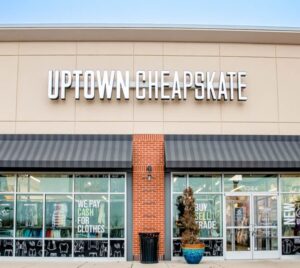
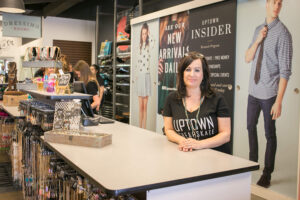
Durable fundamentals are necessary, but alone they are not sufficient. A resale concept still needs to consistently wow its customers to stay relevant. Value gets a shopper in the door once. You need more to keep them coming back. Uptown Cheapskate was built to pair incredible industry fundamentals with a customer experience unlike anything else in resale. Founded in 2008, the brand pairs deep discounts, typically 50–70% off original retail, with a curated, current, and welcoming store experience that feels closer to your favorite boutique than a traditional thrift store.
That combination is the engine. A floor stocked with sought-after brands and current styles, all at unbeatable prices, piques customer interest. An upscale shopping experience makes those customers feel smart about shopping resale – not as though they are accepting compromise. Those dynamics then fuel the other side of the counter, since the same people who shop often sell their clothes back to Uptown. Then there is the operating model. Built on decades of hands-on experience and an industry-leading proprietary software suite, Uptown’s operating model is built to maximize efficiency and throughput – ultimately the name of the game in resale. None of these elements are a marketing layer sitting on top of the business. They are the business, and they show up in the store-level economics.
What the numbers actually show.
Durable demand and a strong concept should translate into real results, and Uptown’s numbers bear that out. According to Item 19 of Uptown Cheapskate’s 2026 Franchise Disclosure Document, among 115 franchised locations operating for a full year, the system average store generated $1,405,704 in gross sales and $227,359 in net income. The top quartile averaged $2,192,785 in gross sales and $423,443 in net income. Set against a total investment of $364,015 to $682,215 (Item 7, with a midpoint of $523,115), those figures point to a return profile few apparel concepts can match. You can see the full breakdown of total investment on the Uptown franchise development website.
A couple of fair questions.
If you are weighing this opportunity seriously, a couple of common doubts are probably surfacing.
First, what if secondhand is just a fad? The data suggests the opposite. Resale has climbed steadily for decades, and its growth is accelerating rather than waning. Gen Z and millennial shoppers are expected to drive more than 70% of resale’s growth through 2030 according to ThredUp’s 2026 Resale Report. These cohorts increasingly treat buying secondhand as a first choice rather than a fallback. That’s not the shape of a fad.
Second, isn’t thrift known for being dusty, dingy, and disorganized? It can be, and that is exactly where a strong resale concept separates itself. Cluttered racks and musty corners are what most thrift stores still deliver. A curated resale store inverts that perception, putting organized, on-trend inventory in a space that is genuinely pleasant to shop. Customers get the thrill of the hunt without compromise.
Is there a catch?
Running a resale store, even one that is franchised, is far from passive income. It’s also not a business you can run from a distance. Resale retail is hands-on, full-time, and a seven-day-a-week commitment, especially in the early years. At Uptown Cheapskate, we look for owners who are excited to be in their stores, lead their teams, and set the tone. In our experience, the people who thrive share three traits that typically don’t show up on a resume: humility, agency, and resilience. Business ownership is hard. The right owner finds energy and fulfillment in personally overcoming those challenges.
So, what is the best clothing franchise to own?
The best clothing franchise is not the one with the trendiest concept or the one making the boldest claims. It is the one whose fundamentals will still be working decades from now. Resale clears that bar more convincingly than most corners of apparel retail. Going a layer deeper, Uptown Cheapskate combines those strong fundamentals with an operating model built for the future. Uptown’s model rests on demand that keeps growing, inventory that sidesteps the apparel industry’s most challenging problems, and an economic profile that rewards owners who run their stores well.
If that is the kind of business you want to build, we would welcome the conversation. A good next step is to understand the resale industry tailwinds behind the model, or to request franchise information and start the discussion on whether Uptown is the right fit. We hold a high bar for who we welcome into our franchise community. You should hold an equally high one for the opportunity you choose.
About the Author:
Tyler Gordon is the Co-CEO of BaseCamp Franchising, the parent company of Uptown Cheapskate and Kid to Kid. At BaseCamp, Tyler helps oversee two of the fastest thrift brands in the United States, with operations that span close to 300 stores. Tyler received his MBA from Harvard Business School and his BA in economics from Harvard College. Tyler and his wife Lindsay live in Salt Lake City with their two young children.
LEGAL DISCLAIMER
Financial performance data sourced from Item 19 of the Uptown Cheapskate 2026 Franchise Disclosure Document, franchised locations only, for the period November 1, 2024 through October 31, 2025. Investment figures sourced from Item 7 of Uptown Cheapskate’s 2026 Franchise Disclosure Document. Results vary by location, operator, and market. A new franchisee’s results will likely differ from these results. This is not an offer to sell a franchise.